
No products in the cart.
A small physiotherapy clinic in Melbourne’s inner north is running circuit classes where the oldest participants are fitter than they were a decade ago. The secret is not working harder. It’s training smarter, together, with someone qualified watching every move.
There is a moment in most people’s fifties or sixties when the body sends a memo.
A knee that grumbles on stairs. A wobble reaching for something on a high shelf. A morning where getting out of a chair takes a fraction longer than it used to. None of it is dramatic. All of it is noticeable.
For a lot of Australians, that memo gets filed under “just getting older” and quietly accepted. But a growing body of research, and a growing number of physiotherapists, say the memo deserves a very different response.
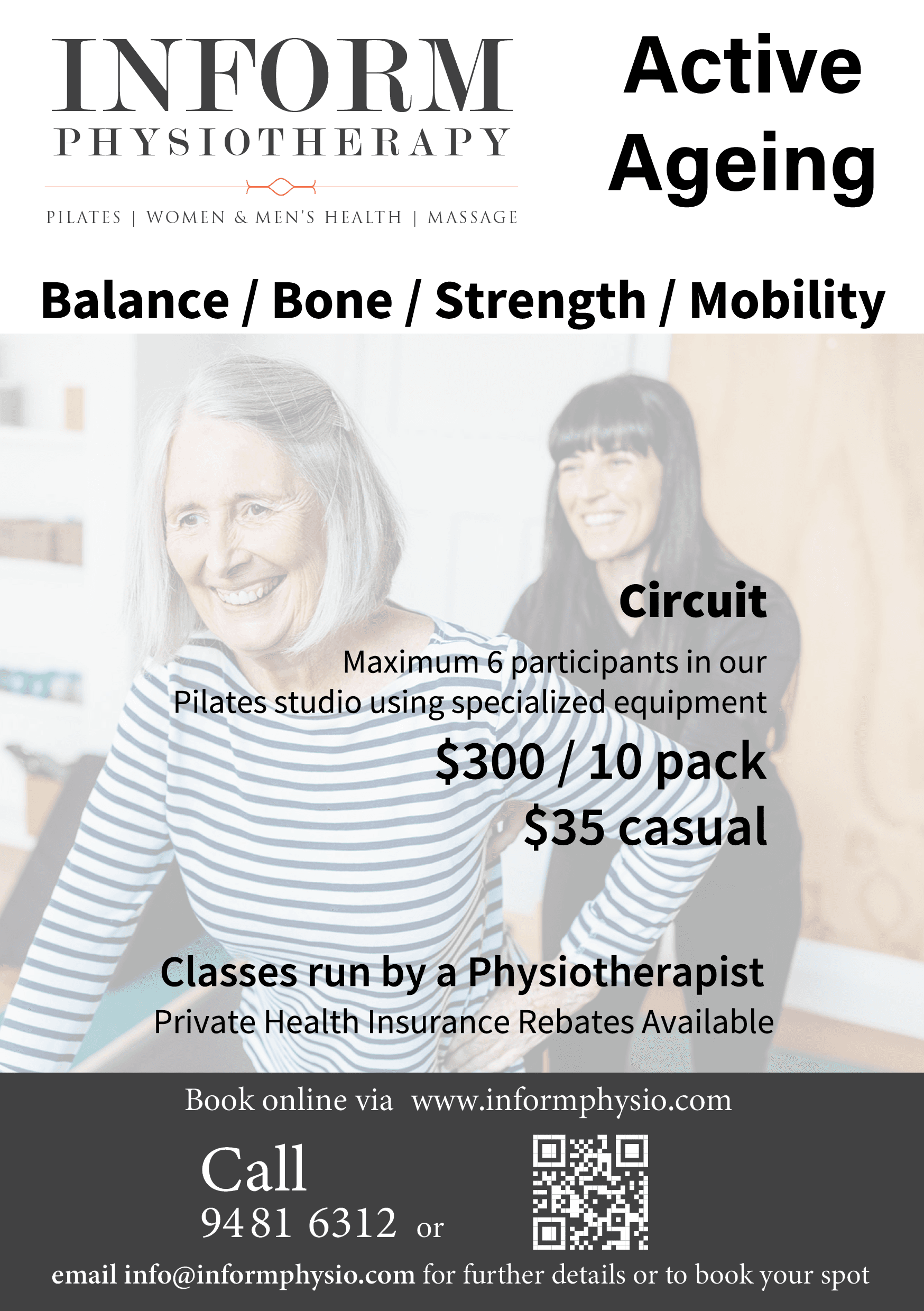
At Inform Physiotherapy in Fairfield, a small-group circuit class called the Active Ageing Circuit is built around a straightforward idea: the things that keep people independent after 50 (balance, bone density, strength, mobility) are all trainable. Not just maintainable. Trainable. As in, genuinely improvable, at any age, with the right approach.
The science is surprisingly optimistic
The clinical term for age-related muscle loss is sarcopenia, and it sounds worse than it needs to be. After about 40, muscle tissue does begin to decline gradually. Sedentary adults may lose up to eight per cent of their muscle mass per decade. But the key word there is “sedentary”. People who keep moving retain significantly more.
More importantly, Australian and international university research shows that older adults can increase both strength and muscle size through resistance training in as little as eight to twelve weeks. Light weights, body-weight exercises and resistance bands can all stimulate new muscle growth when used regularly and progressively.
Balance, too, is retrainable. Falls remain a major cause of injury for Australians over 65, with about one in three experiencing at least one fall each year according to the Better Health Channel. Yet many of those falls are preventable. Balance training works by retraining the brain and body to respond to changes in position, and the improvements can be significant.

What actually happens in the room
The Active Ageing Circuit is not a gym class with a physio hovering nearby. It is designed and supervised by a physiotherapist, capped at six participants, and run in a studio with specialised equipment. That ratio matters. It means exercises get modified on the spot, form gets corrected in real time, and nobody gets lost in the crowd.
A typical session moves through warm-up and mobility work, strength exercises using body weight, resistance bands or light weights, balance drills like step-ups, tandem walking and single-leg stance, functional movements that mimic daily life (think sit-to-stand, carrying tasks), and a cool-down with stretching and breathing. The emphasis is on what the body needs to do at home and in the street, not on gym milestones nobody asked for.
Before anyone joins the group, Inform requires an initial assessment with a physiotherapist to establish goals and current ability, followed by at least one individual exercise session. Only then does a new participant step into the circuit. It is a considered onramp, not a cold start.
Built for real bodies with real histories
One of the more reassuring aspects of the programme is the conditions it is designed to accommodate safely. Inform lists the circuit as suitable for people managing or returning from post-operative joint replacements, osteoporosis, pelvic floor and continence conditions, and osteoarthritis. If previous experience of group fitness has meant gritting teeth through exercises that felt wrong, a class where every movement can be modified by a qualified set of eyes changes the equation.

The thing nobody puts on the flyer
Physiotherapists at Inform note that the changes they see are not only physical. People who can get out of a chair without thinking about it, carry their own shopping, or walk further without fearing a fall start to feel differently about ageing itself. Physical capability feeds confidence, and confidence feeds willingness to stay active. It becomes a cycle that runs in the right direction.
There is also the social dimension. A class of six people, showing up regularly, working through the same challenges, tends to produce the kind of low-key camaraderie that is hard to manufacture and easy to undervalue. For people who may have stepped back from group activities as their bodies changed, that sense of belonging matters.

What it costs and how it works
| Detail | Info |
|---|---|
| Class size | Maximum 6 participants |
| Setting | Studio with specialised equipment |
| 10-class pack | $300 |
| Casual rate | $35 per session |
| Health fund rebates | Private health insurance rebates available |
| First step | Assessment with a physiotherapist, then at least one individual session before joining |
| Location | Inform Physiotherapy, 87 Arthur Street, Fairfield 3078 |
| Phone | 03 9481 6312 |
| Book online | informphysio.com |
Five questions worth asking before joining any active ageing class
These apply anywhere, not only at Inform, and they sort the serious programmes from the generic ones quickly.
The conversation about ageing in Australia is shifting. Slowly, but genuinely. The old assumption that decline is inevitable after a certain birthday is giving way to something more useful: the understanding that the human body responds to the right kind of attention at any age. It just needs to be the right kind.
At a small studio on Arthur Street in Fairfield, six people at a time are proving the point.
At a small studio on Arthur Street in Fairfield, six people at a time are proving the point.
This article is general information only and does not replace individual medical advice. Readers should consult a qualified physiotherapist or healthcare provider before starting a new exercise programme.